-
Training project · Mechanical race car
MECHANICAL RACE CAR.ROLLING BEARINGS AND ISO GPS.
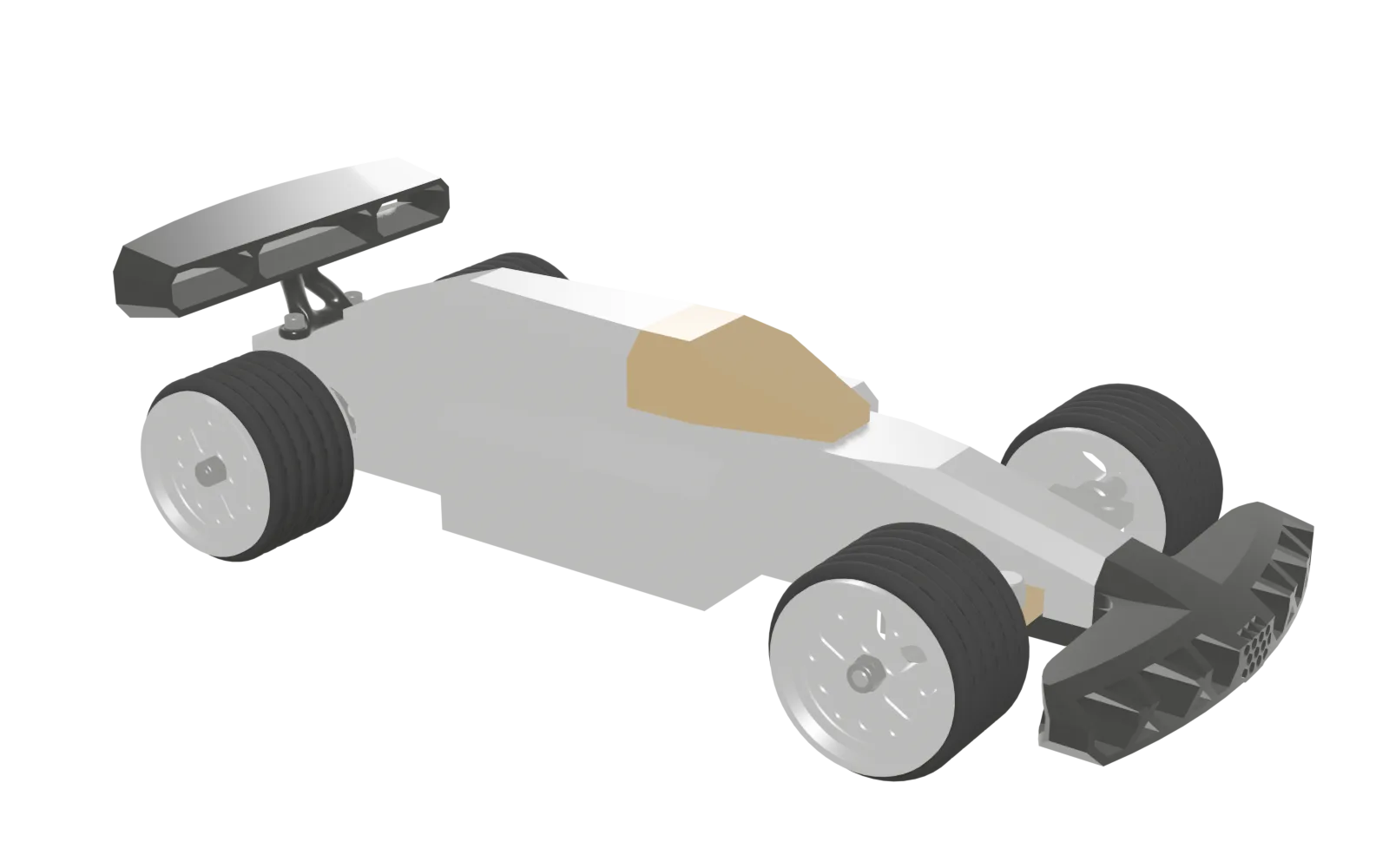
Ball bearings, circlips, envelope requirement: the masterpiece for years 3–4. What you see is our own design model from Fusion: 75 bodies, about 31 centimetres long. Scroll: the model opens up part by part.
-
01 / 14
12 PARTS.EACH ONE MADE.
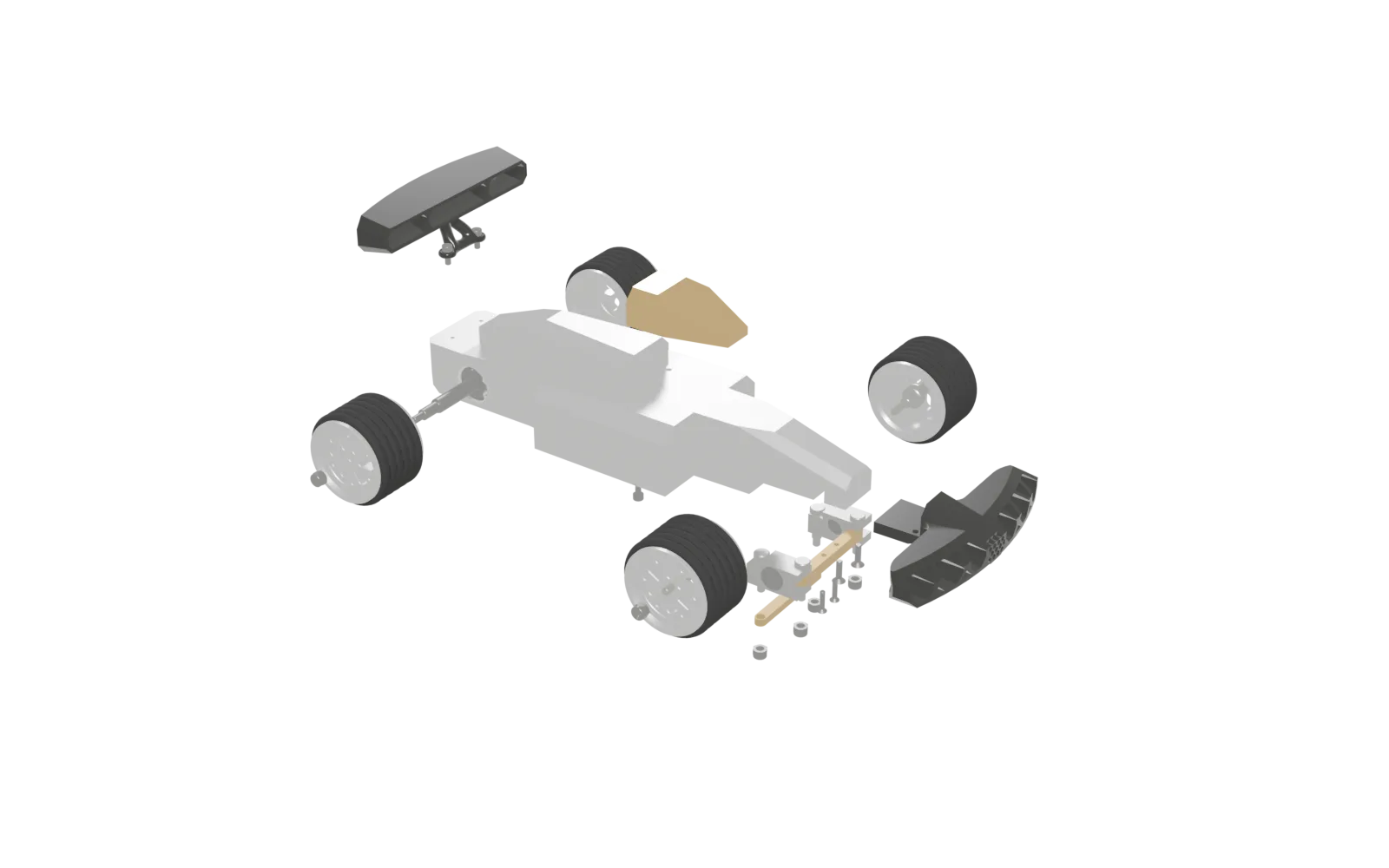
The most demanding project in the portfolio: aluminium 6061 chassis with a Ø22J8 (E) bearing seat, rear axle with Ø8f9 seats, real ball bearings with DIN 471/472 circlips, brass and stainless parts, articulated front suspension, O-ring tyres and two FDM spoilers with dimensioned print parameters.
-
02 / 14
CHASSIS.MILLED.
At about 1.2 kg the chassis is by far the heaviest part of the race car, on its own it carries 62.9 % of the total mass of about 2 kg.
What this part involves
- Check the blank and create the datum face
- Bring the outside contour to size and set the datum
- Rough and finish the internal pockets
- Machine the free-form ramps with the ball nose cutter
-
03 / 14
WHEEL CARRIER.MILLED.
The wheel carrier is a brass flat bar of about 14 g which links the two steering knuckles to the front of the chassis.
What this part involves
- Clamp the strip and mill the first flat side
- Bring the thickness to 5.90 to 5.95 mm
- Set out and centre the hole pattern
- Drill the Ø2.9 mm clearance hole
-
04 / 14
WHEEL CARRIER LEFT AND RIGHT.MILLED.
The left and right wheel carriers are items 3 and 4 of the parts list: two mirror-image steering knuckles of stainless steel AISI 304, each about 23 g.
What this part involves
- Compare both drawings and mark the differences
- Produce the Ø13J7 bearing seat
- Mark the blanks, before the first chip
- Clamp the first part and mill the datum faces
-
05 / 14
TRACK ROD.MILLED.
At about 10 g the track rod is the lightest in-house part of the race car: a brass flat bar 4 −0.1/0 mm thick with two Ø5H8 (E) bores at Ra 0.8 spaced 52±0.1 mm apart and a central Ø3H7 (E) bore, also Ra 0.8.
What this part involves
- Clamp the strip and mill the datum face
- Bring the thickness to 3.90 to 4.00 mm
- Set all three hole positions from one reference edge
- Place the sacrificial plate and pre-drill
-
06 / 14
FRONT AXLE.TURNED.
The front axle is a turned part of stainless steel AISI 304 weighing about 11 g, needed twice, once each left and right.
What this part involves
- Clamp and skim the bar
- Rough the Ø12 collar and the shank
- Rough the journal regions
- Finish Ø4f7
-
07 / 14
REAR AXLE.TURNED.
At 139±0.1 mm long the rear axle is the longest turned part in the project and, at about 60 g, the heaviest after the chassis, windscreen and rims.
What this part involves
- Cut to length, face and centre
- Mount between centres and rough
- Finish the central collar
- Finish the Ø8f9 (E) bearing seats to Ra 0.8
-
08 / 14
SUSPENSION AXLE.TURNED.
The suspension axle is a shouldered pin of stainless steel AISI 304 weighing about 4 g, needed four times, it forms all four joints of the front axle.
What this part involves
- Clamp the bar, skim and face
- Turn the Ø8 mm head to a height of 3 mm
- Rough the shank and thread region
- Finish the Ø5f9 (E) fitted shank to Ra 0.8
-
09 / 14
RIM.TURNED.
At about 48 g each and used four times, the rim is the third heaviest part of the race car, four rims together weigh about 190 g or 9.6 % of the total mass.
What this part involves
- Clamp the bar, skim and face
- Turn the outer contour and rim flanges
- Apply the 20° tapers, chamfers and radii
- Centre, pre-drill, bore the hub recess
-
10 / 14
WINDSCREEN.MILLED.
At about 200 g the windscreen is the second heaviest part of the race car and carries 10.0 % of the total mass, although its base is only 36 × 55 mm.
What this part involves
- Clarify the geometry, then clamp the blank
- Produce the base dimensions 36 × 55 mm and the heights
- Mill the 20° and 105° angular faces
- Mill the 6 × 45° chamfer
-
11 / 14
FRONT SPOILER.PRINTED.
The front spoiler is one of the race car's two FDM printed parts: 125.6 × 60 × 22.11 mm in size, in PLA, weighing about 28 g.
What this part involves
- Check the model and generate the file
- Orient in the slicer and define support structure
- Enter the drawing parameters and document additional settings
- Check the layer count and start the print
-
12 / 14
REAR SPOILER.PRINTED.
The rear spoiler is the race car's second FDM printed part: 119.66 mm wide, 34.33 mm high, in PLA and at about 28 g almost exactly as heavy as the front spoiler (about 28 g).
What this part involves
- Check the model and match the wall thickness in the slicer
- Orient, set a brim, check support structure
- Enter the process parameters and adapt the speed
- Check the layer count and start the print
-
13 / 14
WHEEL CARRIER RIGHT.MILLED.
The right wheel carrier is item 4 of the parts list: the mirror-image counterpart of the left wheel carrier (item 3, drawing 108).
What this part involves
- Compare both drawings and mark the differences
- Produce the Ø13J7 bearing seat
- Mark the blanks, before the first chip
- Clamp the first part and mill the datum faces
-
14 / 14
ASSEMBLED.INSPECTED.
Produce and inspect parts to drawing. Apply tolerances, fits and surface specifications.
What this part involves
- Check completeness and prepare the parts
- Push the deep groove ball bearings onto the rear axle
- Insert the axle with bearings into the chassis
- Fit the DIN 472 D22 retaining rings
Model: Autodesk Fusion, Stern Didactic. Taken over without simplification; what is hidden in Fusion is missing here too.